


27 Oct Chip By Chip: The Surprisingly Meditative Art Of Woodcarving
Key Takeaways
- Your brain loves it: Woodcarving triggers a flow state that lowers stress hormones and quiets the part of the brain responsible for worry and self-criticism.
- It has deep roots: The craft has deep roots in historic Appalachian life, when carving was a practical daily skill long before it became a folk art tradition.
- Community matters: Groups like the Brasstown Carvers show that the social dimension of the craft is just as meaningful as the making itself.
- Beginners are welcome: There are several accessible entry points, including whittling, chip carving, and simple in-the-round projects, with minimal tools required to get started.
- Slow down to gain more: In a culture that rewards constant productivity, carving offers a slow, hands-on practice that produces a tangible result.
Woodcarving is one of those hobbies that invites you to slow down and focus on the task in front of you. With each careful cut, distractions begin to fade, and simple pieces of wood become something meaningful. Here’s why this timeless craft is as rewarding for your mind as it is for your hands.
What Happens To Your Brain When You Pick Up A Carving Tool
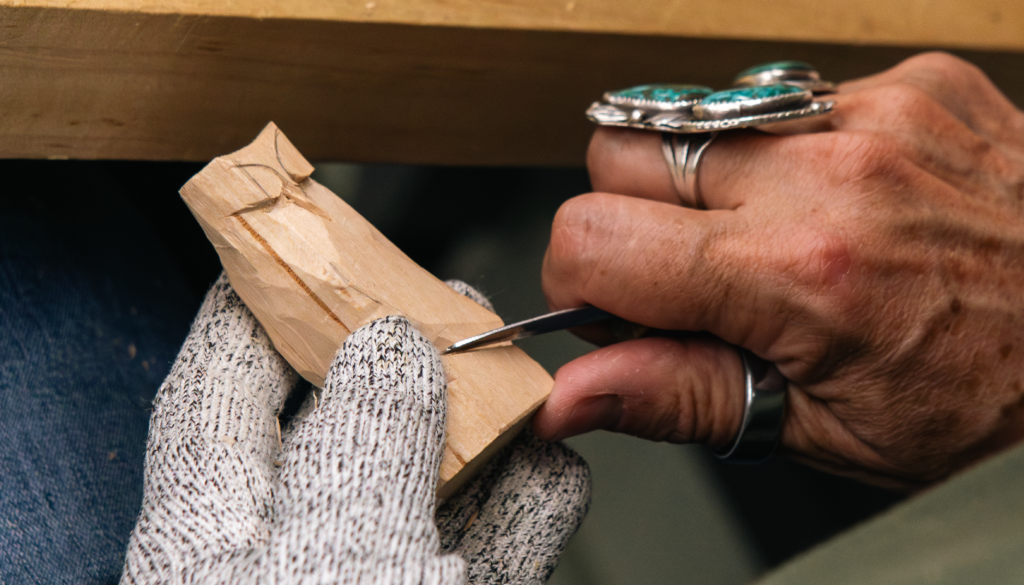
The moment you start carving wood by hand, your brain shifts gears. Repetitive, focused motions activate the parasympathetic nervous system, helping the body settle into a calm, focused state. Heart rate slows. Breathing deepens. It’s the same physiological response you’d get from a meditation session.
This is something psychologists call a flow state. Craft activities like wood carving readily induce flow by balancing challenge and skill, giving immediate feedback as a shape emerges from wood.
Together, these effects help explain why woodcarving is one of the best hobbies that reduce stress. The combination of physical focus and mental absorption gives your mind a break from constant stimulation, making it easier to feel grounded, present, and restored.
A Craft Rooted In Necessity: The Appalachian Woodcarving Tradition
Long before hand-carving wood was a weekend hobby, it was a means of survival.
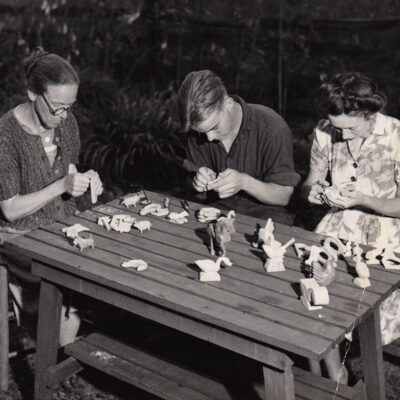
In the mountain communities of Appalachia, wood was the raw material of daily life. If you needed something you couldn’t buy, such as tool handles, kitchen spoons, children’s toys, or fishing rods, you simply carved it. Over time, those practical objects started getting more beautiful. Decorations appeared. Animals and figures emerged from the grain. What began as a necessity became art.
The Brasstown Carvers
The story of the Brasstown Carvers has a wonderfully accidental beginning. Local legend traces it to Olive Dame Campbell noticing a group of men outside Fred O. Scroggs’ general store in Brasstown, North Carolina, whittling away with their pocket knives. When no spare wood was around, they’d carve directly into the bench they sat on.
Campbell saw real potential in those idle hands. She provided the men with blocks of wood and guidance, and a carving cooperative was born. By the 1940s, whittling had become a genuine livelihood for mountain families. One couple even bought their home with the income, calling it “the house that carving built.”
The tradition is still very much alive. Today’s Brasstown Carvers gather weekly, passing down patterns and techniques that have existed for generations, proving that what started on a porch can become a community’s enduring identity.
Watch The Brasstown Carvers, a Best of Our State short film from PBS North Carolina, to see the carvers at work and hear the stories behind a tradition that has shaped this mountain community for nearly a century.
Woodcarving For Beginners
If you’re wondering how to start woodcarving, the honest answer is: chip by chip.
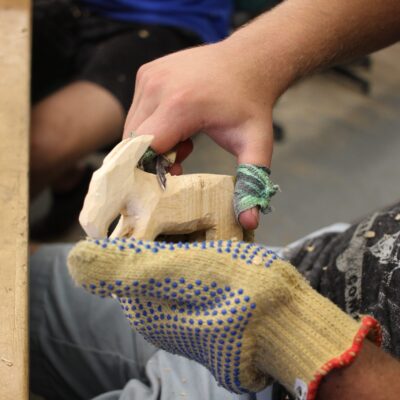
You start by learning your tools. A good carving knife, a gouge, and a chisel will take you surprisingly far. Then you learn to read wood grain, which changes everything, because working with the grain rather than against it is what separates a smooth cut from a frustrating one.
When it comes to beginner carving projects, simpler is smarter. Softwoods like basswood are forgiving and easy to work with, making them ideal for first attempts. Here are some simple wood carving ideas to start with:
- Simple animal figures
- Spoons and small functional objects
- Chip-carved geometric patterns
- Relief carvings of leaves or landscapes
The process itself follows a natural rhythm: choose your wood, plan your design, rough out the shape, add detail, then finish and protect the surface. Most beginners are surprised by how quickly the fundamentals click. Once they do, the possibilities are endless.
Good Things Come To Those Who Whittle
Woodcarving asks you to slow down, pay attention, and trust the process. That’s a rare thing, and it turns out to be exactly what a lot of people need. As one of the most relaxing hobbies you can pick up, carving gives you the satisfaction of making something real with your hands, one careful cut at a time.
It’s even better learned in a community, alongside people who share the same curiosity and the same learning curve. The friendships, the shared mistakes, and the camaraderie around a worktable tend to stick around long after the shavings are swept up.
Ready to pick up a knife and see what you can make? Browse woodcarving classes and find the one that’s right for you.

About The John C. Campbell Folk School
For 100 years, our mission has been to transform lives by bringing people together in a nurturing environment for experiences in learning and community life that spark self-discovery. We believe in the power of non-competitive, hands-on learning across more than 50 craft and art disciplines. From blacksmithing to basketry, music to woodworking, we create space for joy, kindness, and lifelong growth. Every year, we welcome over 6,000 students and 100,000 visitors to our historic campus in Brasstown, North Carolina.
Ready to discover something new? Find a class that speaks to you, or support our mission with a donation to help keep traditional crafts and community learning alive for generations to come.

No Comments